Nutrition & metabolism
Human Recipe decision framework for the festive season
How to enjoy the festive season without losing your biological footing.
Published 22 December 2025

In Holiday strategy without the hangover, we explored a simple but often overlooked truth: the festive season doesn’t challenge health because of one indulgent meal or one late night.
It challenges health through accumulation. Small disruptions, repeated often enough, quietly shift sleep, appetite, mood, and metabolism, until January feels harder than it needs to be.
The Human Recipe Decision Framework was created to interrupt that drift. Not with rules. Not with restriction. But with a small number of evidence-based anchors that protect your physiology while leaving room for celebration.
Think of it as a decision filter: what truly matters this season, and what can be flexible?
The principle: protect the pillars, release the rest
Trying to control everything during the holidays fails under social pressure. Doing nothing creates biological chaos.
Research suggests a better strategy: protect a few high-impact behaviors, and let the rest stay human.
These behaviors form five pillars: meals, alcohol, sleep, movement, and joy & connection.
You don’t need to protect all five perfectly. Choose 2–3 anchors that feel realistic for your life right now.
Meals
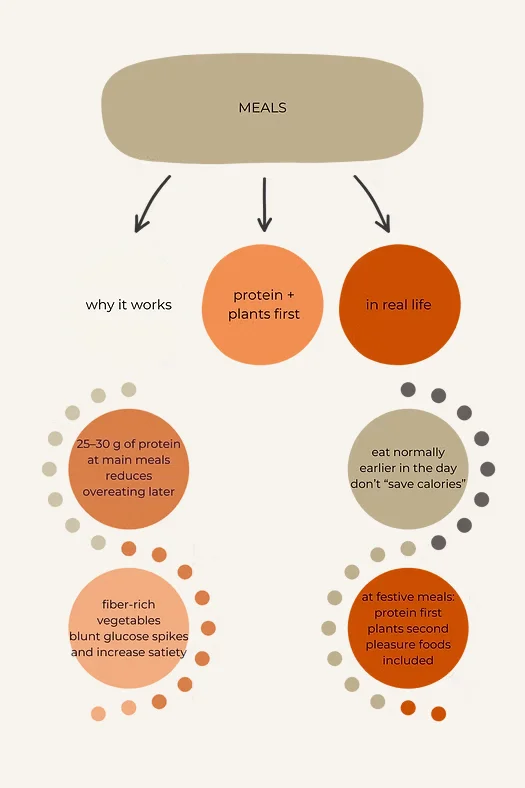
Protein + plants first
Protein (25–30 g) at main meals activates satiety hormones and reduces late-day overeating. Fiber-rich vegetables blunt glucose spikes and increase fullness.
In real life
- Eat normally earlier in the day. Don’t “save calories”.
- At festive meals: protein first, plants second, pleasure foods included.
- Plan indulgence so it stays intentional, not accidental.
This isn’t restriction. It’s sequencing, and sequencing changes biology.
Alcohol
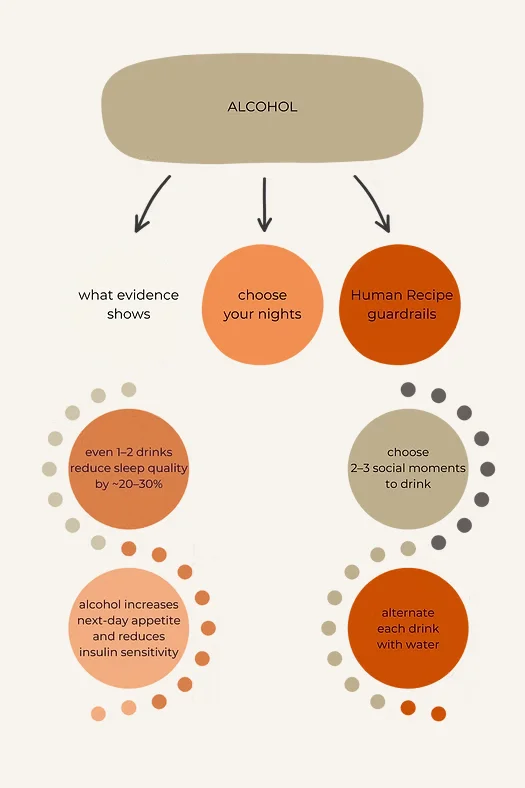
Choose your nights
Even 1–2 drinks reduce sleep quality by ~20–30%, increase next-day appetite, and lower insulin sensitivity.
In real life
- Choose 2–3 social moments to drink.
- Alternate each drink with water.
- Finish alcohol at least 3 hours before sleep.
The biggest risk isn’t one festive evening. It’s repeated nights of alcohol-disrupted sleep.
Sleep
Protect your wake time
Your body runs on an internal clock. When sleep timing becomes irregular, a pattern known as circadian misalignment, metabolic processes lose their rhythm. It’s one of the fastest ways to destabilise appetite, glucose control, mood, and decision-making.
In real life
- Keep your wake-up time within ±60 minutes.
- Get morning daylight, even after late nights.
You don’t need perfect sleep. You need a stable rhythm.
Movement
Muscle reminders, not workouts
Regular movement keeps muscles insulin-sensitive and metabolically active. These small signals help your body process richer meals more efficiently, supporting balance rather than compensating for food.
In real life
- 7,000–10,000 steps per day, or 2–3 short resistance sessions per week.
- The holiday-friendly version: 10–15 minute walks after meals, simple bodyweight circuits at home.
Movement isn’t compensation for eating. It’s metabolic support.
Joy & connection
A pillar, not a loophole
Social connection reduces chronic stress and is associated with better mental health and longevity.
In real life
- A festive meal can be a health behavior.
- Plan indulgence so it doesn’t become drift.
- Eat slowly, socially, and with presence.
Health isn’t the absence of pleasure. It’s the ability to return to balance.
Bottom line
The Human Recipe Decision Framework isn’t about discipline. It’s about discernment. Know what matters. Protect it gently. Let the rest be human.
That’s how you enter January without needing punishment to recover.
This is educational content, not medical advice
This article explains physiology in general terms. It does not diagnose, treat or replace medical care. If you have a medical condition or take medication, discuss alcohol and dietary choices with your healthcare provider.

About the author
Dr. Caroline De Graeve, MD
Human Recipe is a science-driven medical education platform that combines medical expertise with future-focused tools, helping people turn clinical insights into sustainable daily habits for a longer, healthier life.
Dr. Caroline De Graeve, MD, is a physician and founder of Human Recipe. She trained in medicine and nutrition science (Stanford University’s Nutrition Science program). Her work focuses on translating evidence-based lifestyle medicine into clear, practical guidance for women in midlife and beyond.
About the author →