Stress & nervous system
Why the same stress hits two people differently
Published 3 November 2026
Two colleagues give the same presentation, to the same panel, on the same Tuesday. One is tired that evening and fine by Wednesday. The other is still waking at four in the morning two weeks later, replaying it.
The usual explanation is that the second one is more sensitive, or handles pressure less well, or has not learned to let things go. Every version of that explanation puts the difference inside her.
The research looks elsewhere. One of these women had a manager who told her beforehand that the outcome did not matter much. The other is three weeks away from a decision about whether her contract is renewed, and the panel includes the person who will make it. Same room, same slides, and for the body a very different event.
This article is about that difference. Three things explain most of it: the situation, your history, and the people around you. It is part four of the stress series.
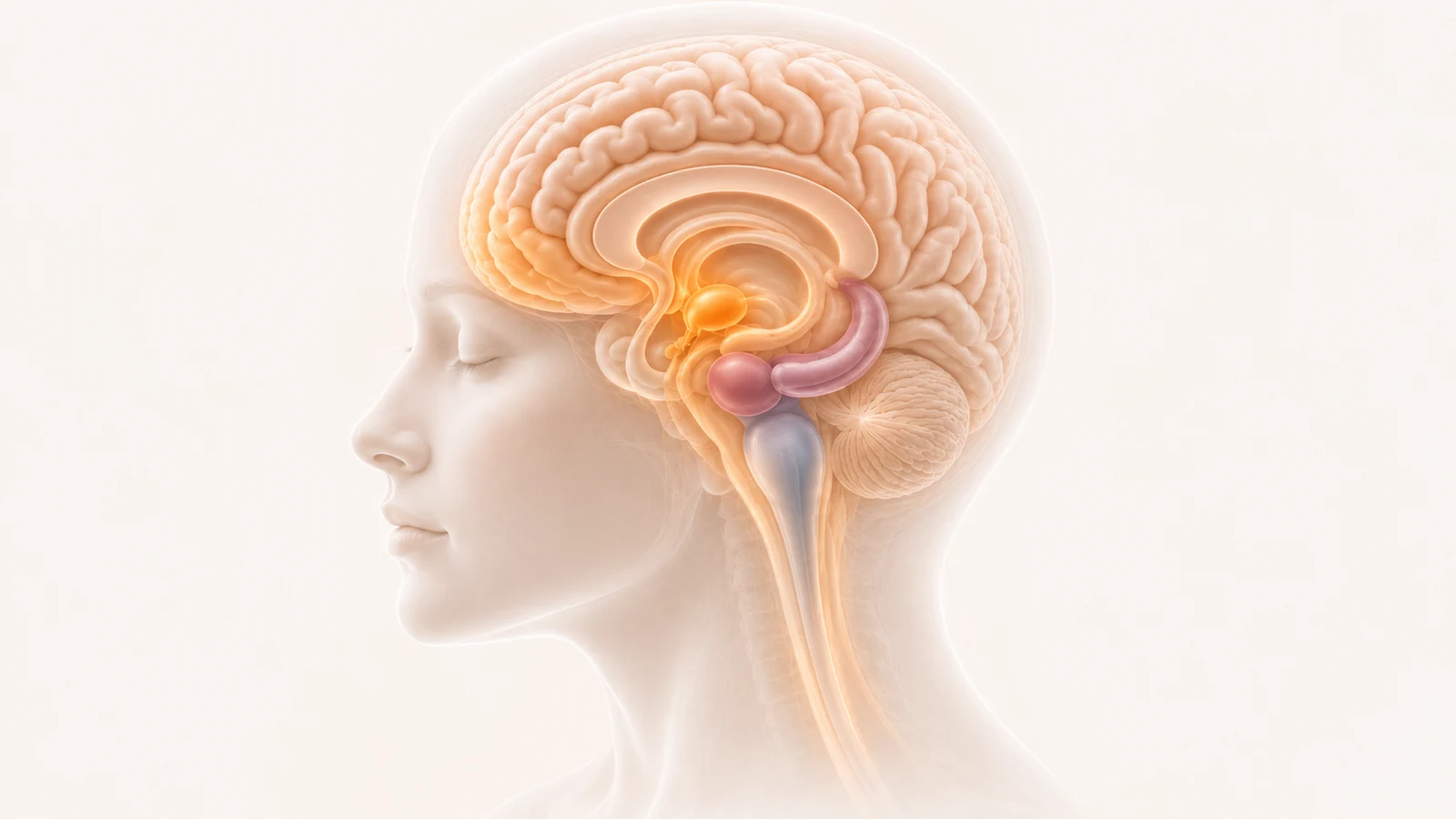
What is well established
Researchers have run hundreds of experiments in which volunteers do something stressful in a laboratory, usually giving a speech and doing mental arithmetic in front of a panel that does not smile back. Afterwards the volunteers give saliva samples, so the researchers can measure cortisol. Cortisol is the body’s main stress hormone. It helps you cope by releasing sugar into the blood for quick energy.
Dickerson and Kemeny collected 208 of these experiments into one big analysis. That kind of study is called a meta-analysis: it combines many earlier studies so that a pattern becomes visible that no single study could show. Two features of a task made the difference. A task that nobody could control raised cortisol, and so did a task in which other people could judge you negatively. When a task had both features, the cortisol response was the biggest and took the longest to come back down (Dickerson and Kemeny, 2004, Psychological Bulletin).
Read that as a description of a situation and the presentation example sorts itself out. Both women were judged. Only one of them had no control over what happened next. The task was the same and the situation was not.
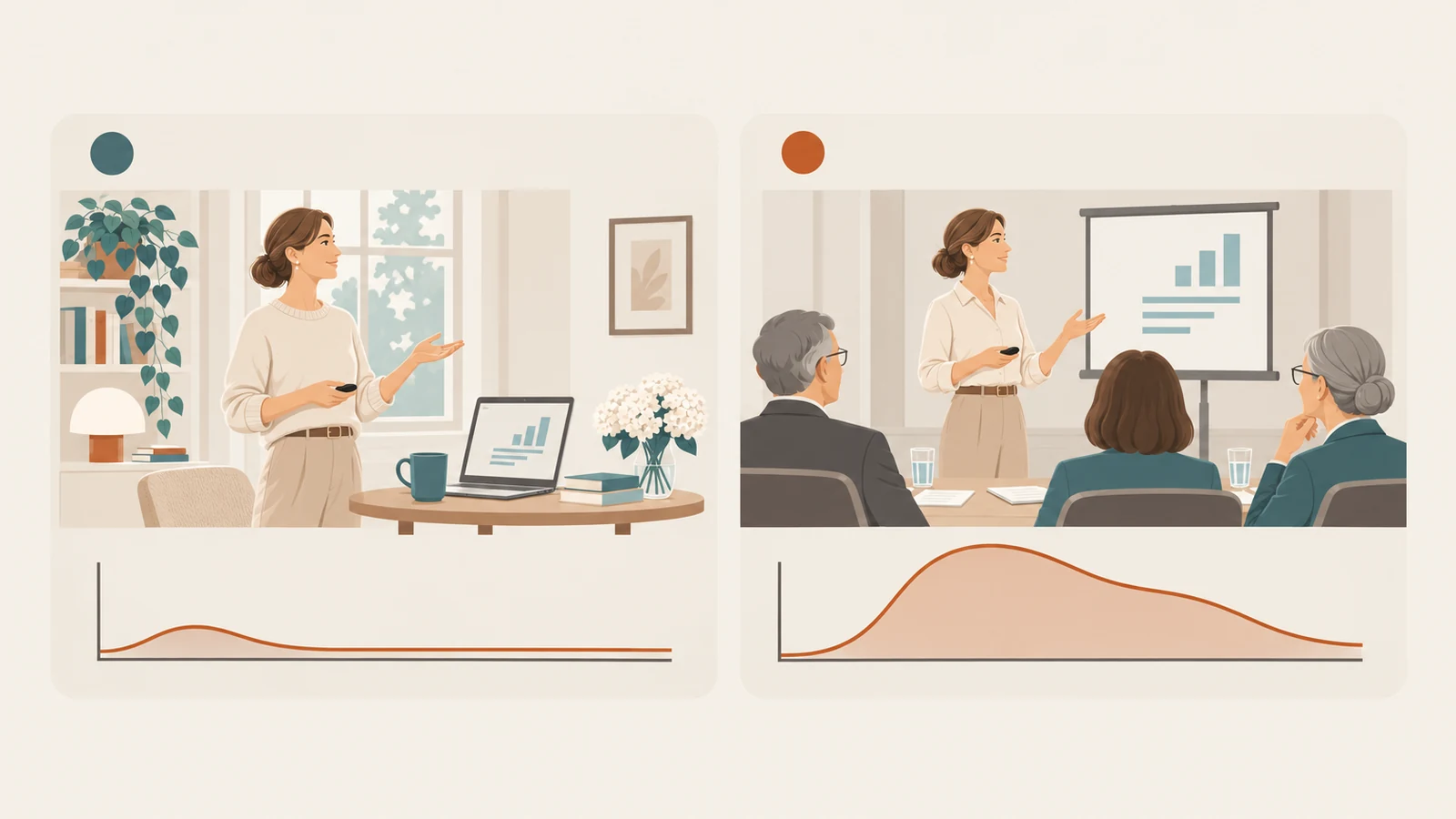
The details of the test matter as well. In a large analysis of this type of experiment, the size of the cortisol response changed with the age and sex of the volunteers, with how long the task lasted, with the sex of the people on the panel, and with the time of day (Seddon et al., 2020, Psychoneuroendocrinology). Change the conditions around an identical performance and you change what the body does. That analysis pooled studies in children and teenagers, so treat it as a detail next to the adult findings above.
In plain words
Your body responds most strongly when two things are present at once: other people can judge you, and you have little control over what happens next. Difficulty on its own does not do it.
The step in between
Between the situation and the hormone sits appraisal. That is the reading your brain makes of what the situation means for you: is this a threat, and can I handle it?
This explains the woman lying awake at four in the morning. She was judged, by people who mattered, about something that mattered. Her brain read that correctly as a big deal. So her body did what a body does in a big deal: it stayed alert, and alert at night means awake.
Challenge versus threat
You may have come across a popular version of this. In a challenge state you judge that you have enough resources to meet the demand. In a threat state you judge that you do not. It has been studied a lot. A recent analysis of 62 studies with 7,418 participants found that people in a challenge state performed somewhat better, for example in school tasks and in sport (Hase et al., 2025, EXCLI Journal).
The differences were small, and the studies measured performance rather than health, so they say little about what happens to a body over the years.
In plain words
Reading a situation as a challenge can help you perform, and it does not change what is at stake.
The part that gets lost in the advice is this. Being told “see it as an opportunity” sounds helpful, and it quietly puts the problem back on you. Your colleague was not calmer because she had a better mindset. She was calmer because her contract was safe. Changing how you look at a situation helps a little. A safe contract helps a lot more.
An anecdote from my own work, with the science behind it. I once prepared a group of women for a real pitch: a live audience, recorded, four minutes each, for social media. Enough stress. Before they went on, I taught them one sentence to say to themselves: “I am excited.” Excitement sits close to anxiety in the body, and the shift from anxiety to excitement is easier than the shift to calm. It is a small trick, and it fits the research above: it nudges the reading of the situation, which nudges the response. It does not change the stakes.
What you bring with you
Earlier experiences may change how the stress system responds, and the direction surprises many people. One analysis of 30 datasets with 4,292 people found that serious hardship early in life was linked to a flatter cortisol response to social stress (Bunea et al., 2017, Translational Psychiatry).
Other analyses found no clear link (Fogelman et al., 2018, Hormones and Behavior), or found a flatter response after severe trauma and a stronger one after milder hardship (Lowe et al., 2021, Neuroscience and Biobehavioral Reviews). So this is a pattern in some studies, and you cannot read your own history from your body. A quiet stress response is also easy to mistake for coping well.
There is one factor in this group that you can influence: how well prepared you are. If you have rehearsed, if you know you can answer the questions, you walk in with a different reading of the situation. Good preparation is part of the job wherever the situation allows it.
In plain words
Early hardship may leave the stress response flatter, and the studies on that disagree with each other. Preparation is the part you can change, because it changes how you read the situation.
How the people around you support you matters
You would expect that support from people close to you calms the body. The evidence is messier than that, and most of the mess concerns women.
In one of the early studies, men who waited for a public speaking task with their partner had clearly smaller cortisol responses. Women did not get that effect. A stranger’s support changed nothing, and their partner’s support showed a small rise instead, which could easily be chance (Kirschbaum et al., 1995, Psychosomatic Medicine). 🙂
A later study in 67 women found that a partner’s neck and shoulder massage before a stress test lowered the cortisol and heart rate response, while ten minutes of verbal support changed nothing (Ditzen et al., 2007, Psychoneuroendocrinology).
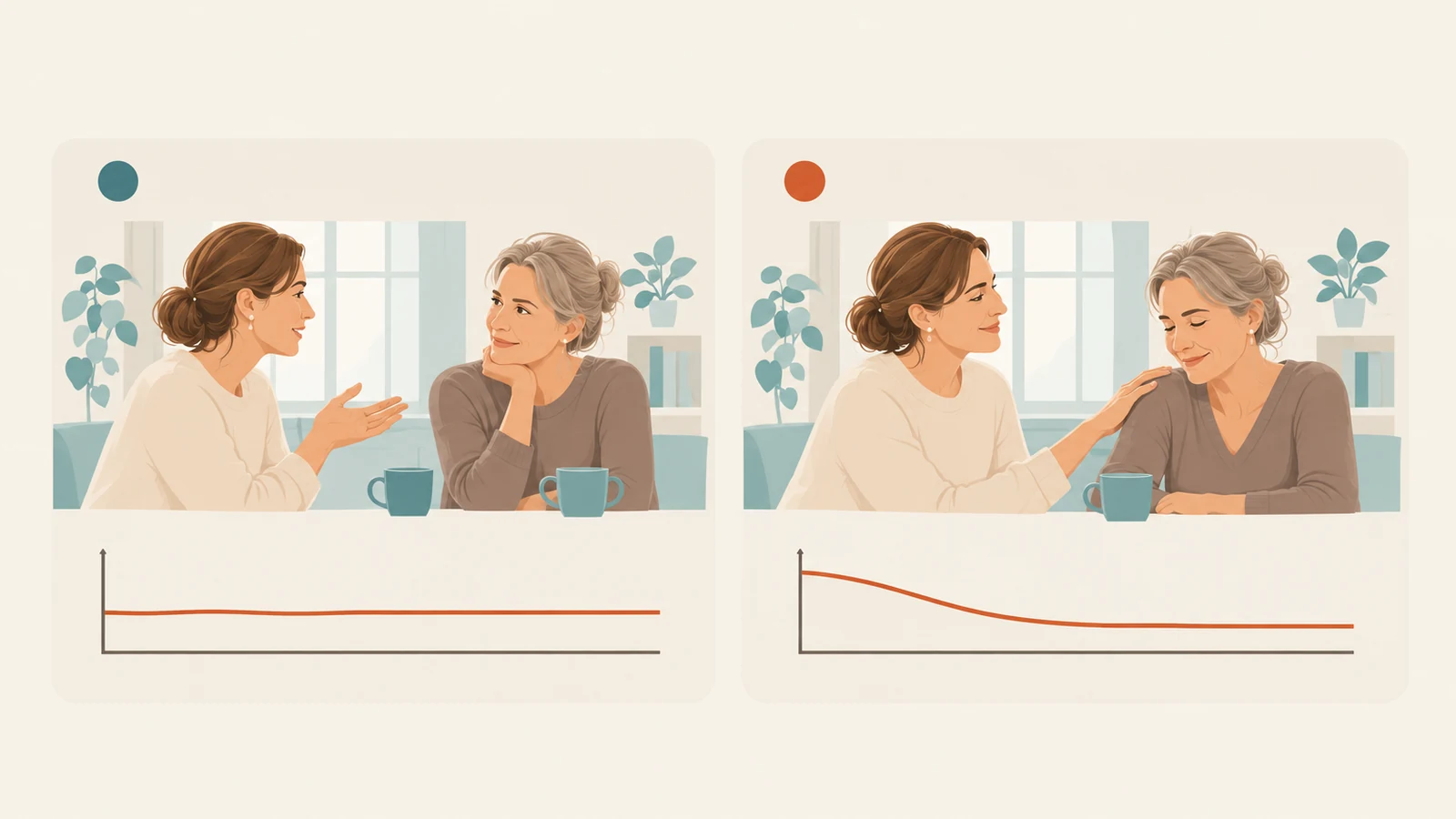
A stress-management programme built around social support lowered how stressed women said they felt, and changed none of the body measures (Heimgartner et al., 2021, PLoS ONE). That trial was small.
Across these studies, support changes how stressed a woman says she feels. Whether it changes what her body does is still unclear, and the studies that have asked it are small and short.
In plain words
Feeling supported helps how stressed you feel. Physical contact seems to do more for the body than words alone, and the evidence for that is still thin.
What this adds up to
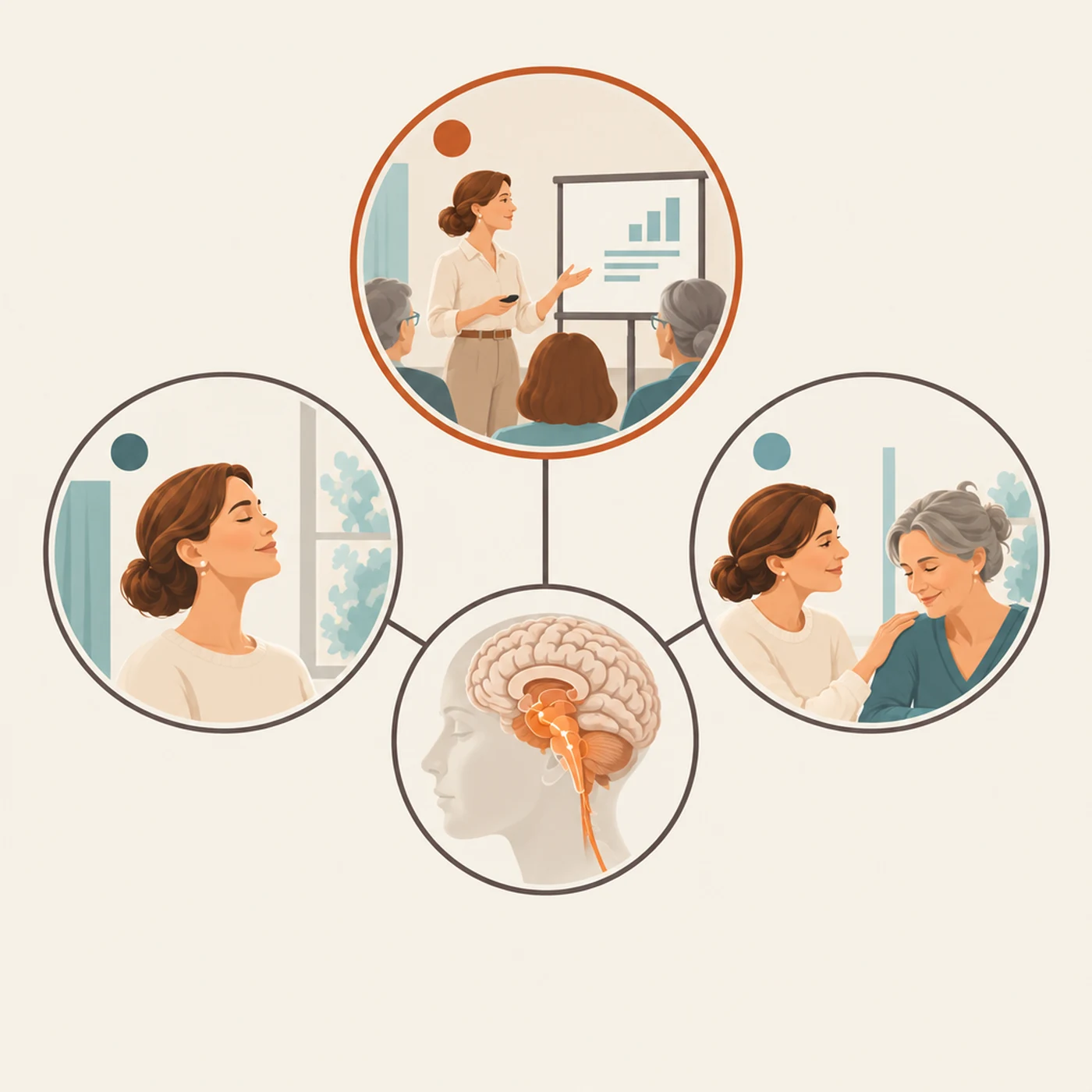
Three things account for most of the difference between two people facing what looks like the same event. The first is the situation, above all whether someone is judging and whether she has any control. The second is what she brings, meaning a history that may already have calibrated her system, plus how prepared she is. The third is who is with her, where the kind of contact seems to matter more than the fact that someone is there. Of the three, the first rests on the strongest evidence and the second on the weakest.
None of these is a character trait. Two are circumstances and one is history.
That matters in practice, because most of what is sold for stress aims at how the woman interprets things, which is the part with the smallest and least health-relevant evidence. The parts with the best support are things nobody sells: how much control you actually have, and what the room is like.
What comes next
The next article looks at something that changes all of this from the inside. The brain areas that steer the stress response have receptors for estrogen, a sex hormone. During perimenopause, the years around the last period when hormone levels swing up and down, the conditions those areas work in stop being stable. The article looks at what that does, and at what the evidence supports.
If you take one thing from this
When your reaction to something seems out of proportion compared with how someone else handled it, put the comparison aside for a moment and ask a different question. What was different about the two situations? Who was judging, what was at stake for each of you, and how much control did each of you have over what happened next? Most of the time the answer is that she was not in the same situation you were.

About the author
Dr. Caroline De Graeve, MD
Human Recipe is a science-driven medical education platform that combines medical expertise with future-focused tools, helping people turn clinical insights into sustainable daily habits for a longer, healthier life.
Dr. Caroline De Graeve, MD, is a physician and founder of Human Recipe. She trained in medicine and nutrition science (Stanford University’s Nutrition Science program). Her work focuses on translating evidence-based lifestyle medicine into clear, practical guidance for women in midlife and beyond.
About the author →Sleep workshop
Where the stress system resets
Sleep is where the stress system either resets overnight or does not, and cortisol’s own daily rhythm shapes how well it does. The workshop covers why sleep shifts at this life stage, what the evidence supports, and how to build a starting protocol that fits your pattern. Two live sessions: Wednesday 4 November, 20:00 to 21:30 CET, and Saturday 7 November, 09:00 to 10:30 CET. €85 per person.
References
This is educational content, not medical advice
This article explains physiology in general terms. It does not diagnose, treat or replace medical care. If you have concerns about stress or perimenopausal symptoms, consult a licensed clinician. Evidence classification follows The Filter framework: the quality and totality of evidence, the meaningfulness of the effect, and real-life applicability. Certainty language reflects the current state of the literature.