Sleep & recovery
Why you wake at 3am
Published 1 September 2026
You fall asleep fine. You are not anxious about anything in particular. And yet, night after night, your eyes open somewhere between two and four in the morning, and your mind switches on as if the day had started. Many women treat this as a personal failing: too much caffeine, too much screen time, not enough discipline. Mostly, it is none of those things.
The pattern is physiological
Sleep is not one long, flat state. It moves in cycles of roughly 90 minutes, and in the second half of the night those cycles contain progressively less deep sleep and more lighter, dream-rich sleep. By around three in the morning you are sitting close to the surface. Anything that nudges your body slightly, a warmer room, a full bladder, a sound, a dip in blood sugar, can now push you through that surface and wake you.
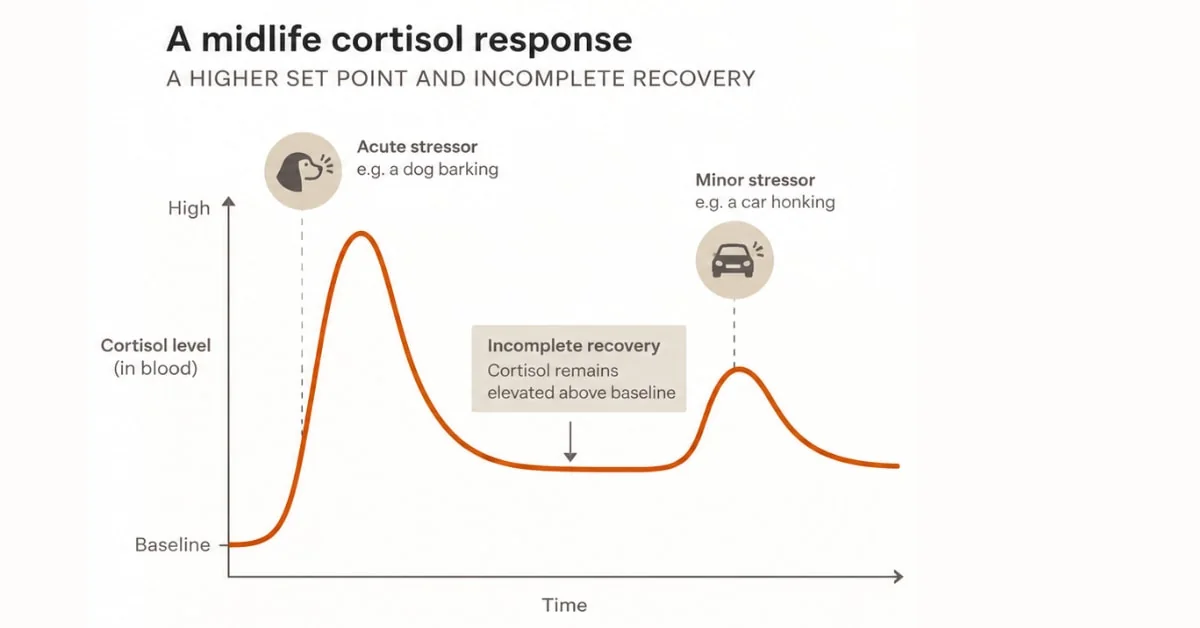
At the same time, cortisol follows its own rhythm. It is lowest in the early evening and starts rising in the small hours as part of the wake-up sequence. In a well-regulated system, that rise is slow and patient. But when the stress system has been running on high demand for months, and especially when hormones are shifting during the years around menopause, that early morning rise can arrive earlier and steeper. Your brain receives a wake signal long before the window opens.
What it is not
Notice what this explanation does not contain: a diagnosis, a disorder, or a verdict about you. Early morning waking is extremely common, and it becomes more common in midlife. It is also worth saying what this article does not claim: that the mechanism above explains every case. Sleep is influenced by thyroid function, medication, alcohol, mood, pain and apnoea, among other things. If waking is paired with exhaustion that affects your day, or with snoring and pauses in breathing, that is a conversation for a doctor, not for an article.
What actually helps
The most useful shift is from fighting the wake-up to reducing the forces that push you through the surface. Three practical translations follow directly from the mechanism.
First, protect the front of your night. Alcohol fragments the second half of sleep specifically, which is why a glass of wine at dinner shows up as a 3am wake-up rather than as trouble falling asleep. Second, treat the last hour of the evening as descent time: dimmer light, lower stimulation, cooler room. You are not optimising, you are lowering the noise floor under the whole night. Third, if you do wake, resist the arithmetic. Checking the time converts a brief surfacing into a calculation about tomorrow, and the stress response makes the cortisol curve steeper, not flatter. Lie still, breathe slowly, and let the body decide.
The honest summary
Waking at 3am is usually information, not a verdict. The mechanism is well understood in outline, the practical countermeasures are modest and free, and the evidence for dramatic single-cause fixes is thin. If a supplement, device or protocol promises to erase this pattern, ask what study supports that promise. The Filter applies here too: interesting idea, modest evidence, and no substitute for the basics or for medical care when something more serious is going on.

About the author
Dr. Caroline De Graeve, MD
Human Recipe is a science-driven medical education platform that combines medical expertise with future-focused tools, helping people turn clinical insights into sustainable daily habits for a longer, healthier life.
Dr. Caroline De Graeve, MD, is a physician and founder of Human Recipe. She trained in medicine and nutrition science (Stanford University’s Nutrition Science program). Her work focuses on translating evidence-based lifestyle medicine into clear, practical guidance for women in midlife and beyond.
About the author →This is educational content, not medical advice
This article explains physiology in general terms. It does not diagnose, treat or replace medical care. For persistent sleep problems or anything that affects your daily life, consult a healthcare provider.