The stress response has an off switch.

Updated: Sep 10

What happens when it does not shut off cleanly?
You know what I mean. A difficult conversation ends, a deadline passes, and something in your body is still running. Your heart has slowed. The situation is over. But you are still alert in a way that takes a while to settle.
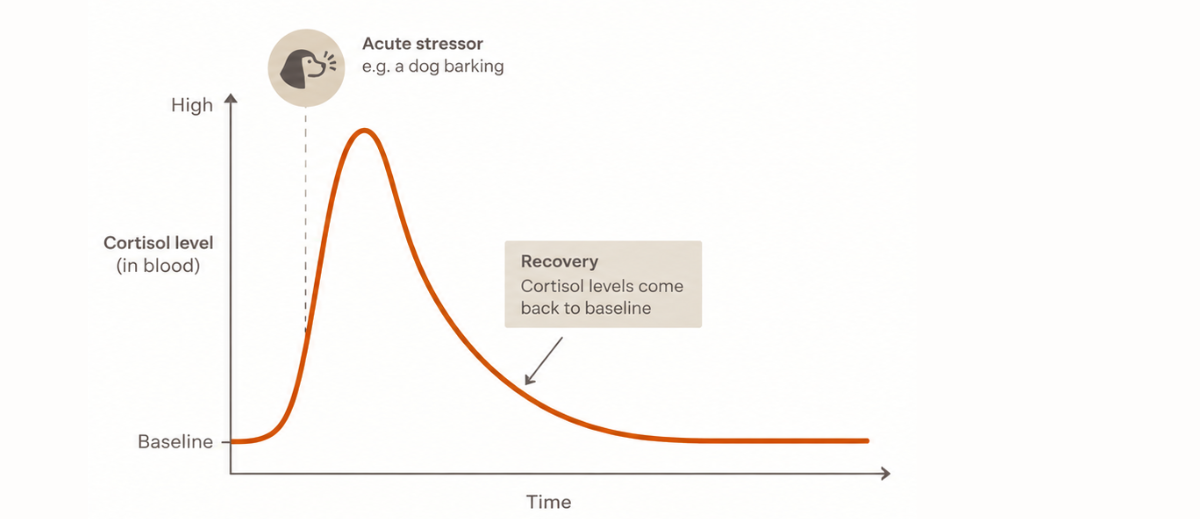
That is the stress response doing exactly what it was built to do: activate fast, sustain long enough to be useful, then shut off.
The shut-off part is what this article is about.
It is not instant. The situation ends before the body does. You are no longer under threat. You are winding down. The alertness that lingers during that window has a particular quality. It sits in the chest and the shoulders. It makes ordinary sounds feel slightly louder than they should. It means that if something unexpected happens in the next hour, your reaction will be sharper than it otherwise would be. The body is still ready for something, even though the thing that required readiness has already resolved.
For many women in their late forties and early fifties, this pattern has become more pronounced than it used to be.
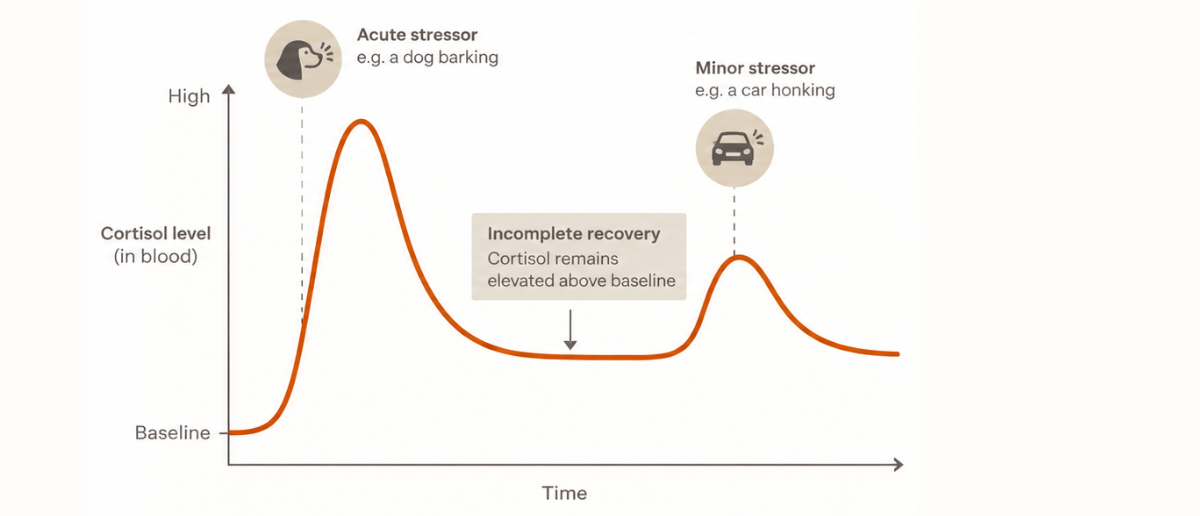
The same stressors that felt manageable ten years ago take longer to clear. Sleep that should be restorative is not quite. The recovery between difficult days does not fully complete before the next one arrives.
The temptation is to explain this as a failure of discipline or character. The more accurate explanation is biology.
The core idea, before anything else
The stress response is a precision system. It includes a specific mechanism for turning itself off.
When that shut-off process runs cleanly, the body returns to a resting state relatively quickly. When it does not, the consequences accumulate in ways that show up in sleep, in concentration, in mood, and in the quality of recovery between demanding days.
At midlife, and particularly in the years around perimenopause, one of the inputs that has been calibrating this system for decades begins to shift. Understanding what that means, and what remains within reach, is the purpose of this series.
The loop with the built-in off switch
The system responsible for the stress response has a name: the HPA axis, after the three structures it connects.

When the brain registers a threat (through perception, memory, anticipation, or imagination alone) a region deep inside it called the hypothalamus perceives the threat and sends a chemical signal downward.
That signal reaches the pituitary gland, a small structure sitting just below the hypothalamus, roughly the size of a pea. The pituitary releases a hormone into the bloodstream that travels to the adrenal glands, two small structures sitting on top of each kidney.
The adrenal glands then release cortisol.
Cortisol raises blood glucose to fuel the body, sharpens attention, and temporarily redirects energy away from functions that can wait during a threat: digestion, certain immune processes, reproduction.
Once the threat has passed, cortisol itself feeds back to the brain and tells the system to stop producing it. It is a loop with a built-in off switch.

Under normal conditions, this loop closes. The return toward a resting state takes tens of minutes to a few hours, depending on the nature and intensity of the stressor. The system is designed to be temporary and self-terminating.
What changes at midlife
The HPA axis does not operate in isolation. It is sensitive to sleep quality, to the accumulation of repeated demands over time, to aging, and to estrogen.
Estrogen receptors are present in the hypothalamus, in the pituitary gland, and in the hippocampus (a brain region involved in memory and in moderating the stress response). For decades, estrogen has been part of the biological environment within which the HPA axis is calibrated.

What becomes relevant at midlife, and particularly in the years around perimenopause, is that estrogen does not simply decline in a straight line.
Before stabilising at a lower level in postmenopause, it fluctuates, sometimes sharply, over a period of several years.
That instability appears to be what disrupts the calibration of the stress loop for some women. When the regulatory signal keeps moving, stress regulation becomes less consistent in its responses.
This shows up differently in different people. Slower recovery after stressful events. A lower threshold before the system activates. Difficulty returning to a resting state at night. Often a combination of these.
The HPA axis as a stress regulation system is among the most replicated findings in psychobiology.
The feedback role of cortisol
and the sensitivity of this system to hormonal status, sleep, and chronic load
are well-characterised in the research literature.
What comes next
This article has one job: to orient you.
The next 4 articles work through the mechanism in sequence.
Article 2 explains what cortisol actually does during a stress response, and how the feedback loop is supposed to work.
Article 3 addresses where health risk actually accumulates over time (the answer is more specific than “stress is bad for you”).
Article 4 walks through what perimenopause changes in the stress system, and why.
Article 5 maps the evidence-based levers: what is actually within reach, and what the research supports with what level of confidence.
If you take one thing from this
In the coming week, notice the moments when a stressful situation is clearly over, but some alertness in your body is still lingering: the kind that sits in the shoulders, the kind that makes the evening feel slightly louder than it should. Name it for what it is. You are experiencing the shut-off mechanism running later than it should. You do not need to do anything about it. Naming it is enough as a starting point.
Sleep and the shut-off mechanism
Sleep quality is one of the inputs that calibrates the shut-off mechanism this article describes. Disrupted sleep is often part of an incomplete recovery pattern between difficult days.
In November I am running a small-group online workshop on exactly this connection: what actually happens to recovery during sleep, and what is within reach to protect it. Two live sessions to choose from.
This is educational content, not medical advice. If you have concerns about stress or perimenopausal symptoms, consult a licensed clinician.
Evidence classification in this article follows The Filter framework: Evidence (peer-reviewed, replicated), Applicability (relevant to midlife women in real-world conditions), Health Benefit (meaningful, measurable outcome). Certainty language reflects the current state of the literature.
References
Herman JP, McKlveen JM, Ghosal S, et al. Regulation of the Hypothalamic-Pituitary-Adrenocortical Stress Response. Comprehensive Physiology. 2016;6(2):603–621.
(Full citation sets for the mechanism, allostatic load, perimenopause, and practical levers appear in Articles 2–5.)
Want one piece of health science made clear each week? Start with the free guide, 5 evidence-based habits for a longer, healthier life and receive the Human Recipe newsletter.
Human Recipe is a science-driven medical literacy platform
that combines medical expertise with intelligent, future-focused tools, helping people turn
clinical insights into sustainable daily habits for a longer, healthier life.

Dr. Caroline De Graeve, MD, is a physician and founder of Human Recipe. She trained in medicine and nutrition science (Stanford University’s Nutrition Science program). Her work focuses on translating evidence-based lifestyle medicine into clear, practical guidance for women in midlife and beyond.

Comments