What cortisol actually does during a stress response.

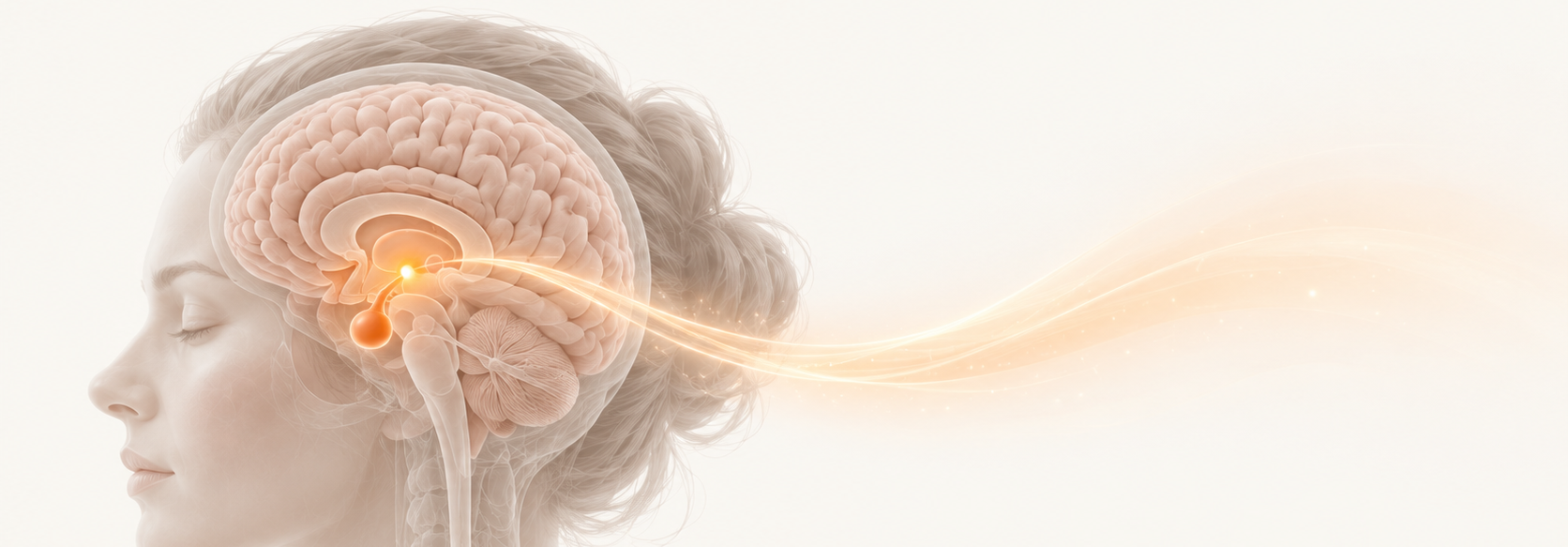
A message arrives before a meeting: can we talk before we start? Nothing else. No context. For the next twenty minutes your attention narrows to that one line. Your chest tightens. The work in front of you barely registers.
That narrowing has a mechanism, and it runs through three organs in your body.
Before the mechanism: one piece of orientation.
A stress response is a sequence rather than a single event, and it has 4 steps you can ask about separately:
what happened
what your brain made of it
what your body did
and whether the system switched off cleanly afterwards
This article is about the third step.
And one word to settle first.
To your body, a stressor is anything that disturbs the internal balance or threatens to.
An infection is a stressor. So is blood loss, a broken bone, a night without sleep, a blood sugar that drops too low, childbirth. So is that one line on your screen. These do not all reach the same system by the same route.
Two systems, two timescales
When people say they are running on adrenaline, they are usually describing only half of what is happening.

The first response is the
sympathetic-adrenal-medullary system, SAM for short. It is a fast circuit that releases adrenaline and noradrenaline within seconds of a threat. This is the racing heart, the sudden alertness, the jump when a car horn sounds behind you. It resolves quickly once the immediate danger passes.
The second response is slower and less visible. It is the hypothalamic-pituitary-adrenal axis, the HPA axis, and it unfolds over minutes rather than seconds.
Where SAM handles the immediate jolt, the HPA axis sustains and coordinates the response, and, just as importantly, contains the mechanism that eventually shuts it down. It is the system that determines how you feel an hour after the stressful moment has passed, not only during it.

The relay
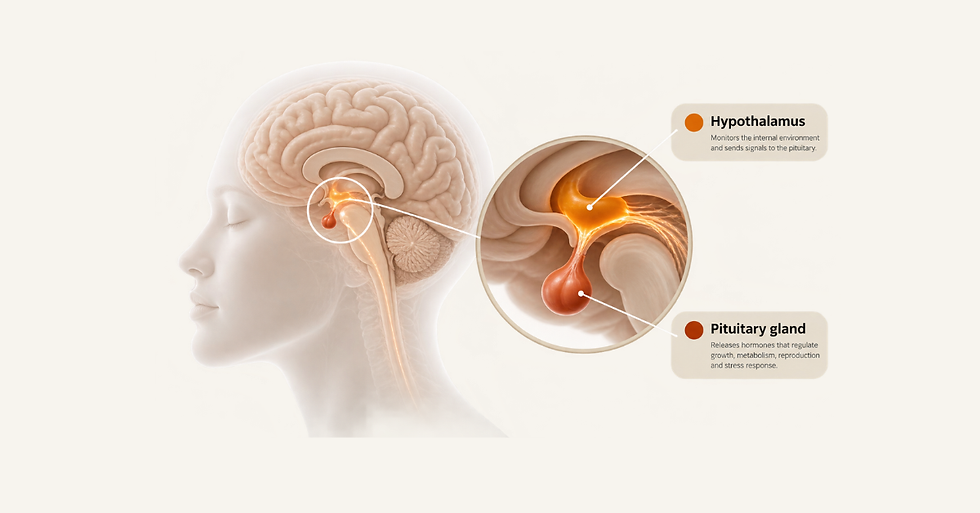
The HPA axis is a three-step hormonal chain, and each step has a physical location in the body.
When the brain appraises something as threatening, whether that is genuine physical danger, a memory, or simply the anticipation of a difficult conversation, a region called the hypothalamus releases a signalling hormone (CRH).
That signal travels a short distance to the pituitary gland, a structure roughly the size of a pea sitting just below it. The pituitary releases a second hormone (ACTH) into the bloodstream, which travels down to the adrenal glands, two small structures sitting on top of each kidney.
The adrenal glands respond by releasing cortisol.

The adrenal gland is not one uniform structure.
It has an outer layer, the cortex, and an inner core, the medulla, and the two release different hormones.
Cortisol comes from the cortex, which is where its name comes from.
Adrenaline comes from the medulla, and its name comes from the location of the gland itself: ad renes, Latin for near the kidney.
The fast SAM response and the slower HPA response you read about above both trace back to this same small organ, just to different parts of it.
What cortisol actually does
Cortisol is often described as though it were a single, blunt stress hormone. In reality it performs several distinct jobs at once, and all of them are adaptive in the short term.
It raises blood glucose, drawing on the liver and on fat and protein stores, to make fuel available quickly.
It sharpens attention and helps encode what is happening into memory, which is part of why stressful moments are often easy to recall in detail.
It temporarily reduces energy spent on functions that can wait, including digestion, reproduction, and some immune activity.
And it works alongside adrenaline and noradrenaline to support the cardiovascular changes, such as increased heart rate, that a genuine threat would require.
None of this is a malfunction. It is what a coordinated, short-term response to a real demand looks like.
Cortisol also follows its own daily rhythm, independent of any specific stressor. It normally peaks shortly after waking and declines through the day.
This means a single cortisol measurement, taken on its own, says very little. Interpretation depends on the time of day, what preceded it, and the shape of the response over time, not one number.
How the response ends
The same hormone that activates the response also contributes to ending it.

Once cortisol is circulating, it acts back on the hypothalamus and pituitary through receptors that sense its level and reduce further signalling accordingly.
This is negative feedback: cortisol telling the system that enough has been released, and it is time to stop.
Some of this feedback happens quickly, within minutes. Some of it happens more slowly, over hours, through several sites in the brain rather than one central switch.
The hippocampus, a brain region also involved in memory, is one of several structures that contribute to this braking process. It is not the only one, and how much it contributes depends on the specific stressor. There is no single control point.
The regulation is distributed and context-dependent, which is part of why two people can respond quite differently to what looks like the same stressful event.
Two kinds of stressor
That context-dependence starts earlier than the braking, in how the demand reaches the axis at all.
Some stressors are physical disruptions of internal balance. The body does not need to interpret an infection or a fall in blood sugar. Signals arriving from the brainstem and from the bloodstream drive the hypothalamus directly, and cortisol rises whether or not you have any thoughts about it.
Herman and colleagues call these reactive responses (Herman et al., 2016, Comprehensive Physiology).
Other stressors are not disruptions yet. They are predictions. A message before a meeting has not harmed you. What activates the axis is your brain's reading of what it might mean, and that reading travels a longer route, through limbic structures including the amygdala, before it reaches the hypothalamus. These are anticipatory responses.
Two roads, one relay. The distinction is worth keeping when you read anything about stress, because findings from one category do not transfer automatically to the other, and the research most people encounter, including what follows here, is almost entirely about the anticipatory kind.
Not all stress is equal
Within that anticipatory category the responses are still not equal.
The size of the cortisol response depends heavily on what kind of situation it is, not simply on the fact that a situation occurred.
A meta-analysis of 208 laboratory studies (Dickerson and Kemeny, 2004, Psychological Bulletin) found that the largest and longest cortisol responses came from situations combining two specific features:
the possibility of being judged negatively
and little or no control over the outcome.
A performance review with an uncertain outcome fits that pattern closely. A passive task, such as watching a neutral video, often produced no measurable cortisol response at all.

So the common claim that any stress raises cortisol is an oversimplification. A physical stressor such as an infection will raise cortisol regardless of how you feel about it. But among the situations your brain has to interpret, and those are most of what people mean when they say they are stressed, the response is far more selective than it appears. It is strongest when judgment and a lack of control appear together.
Evidence: Strong. Mechanism: Established.
What comes next
Under normal, occasional stress, this loop functions as designed: activation, a coordinated response, and a return to baseline within tens of minutes to a few hours.
The next article takes up what happens when this sequence runs over and over, without enough recovery in between. How well, and how consistently, the system returns to baseline is an open question, and an actively contested one.
If you take one thing from this
In the coming week, notice a moment when your reaction feels out of proportion to the situation: a delayed reply, a small piece of unexpected feedback, a minor mistake pointed out in front of others.
Ask honestly whether the situation involves being judged and offers you little control. If it does, that is not an overreaction. It is your physiology responding, accurately, to exactly the kind of threat it is built to take most seriously.
Sleep and stress recovery are more entangled than they first appear, partly because cortisol’s own daily rhythm shapes how well the system resets overnight. In November I am running a small-group online workshop on exactly that connection: what actually happens to recovery during sleep, and what is realistically within reach to protect it. Two live sessions to choose from.
This is educational content, not medical advice. If you have concerns about stress or perimenopausal symptoms, consult a licensed clinician.
Evidence classification in this article follows The Filter framework: Evidence (peer-reviewed, replicated), Applicability (relevant to midlife women in real-world conditions), Health Benefit (meaningful, measurable outcome). Certainty language reflects the current state of the literature.
Scientific References
Herman JP, McKlveen JM, Ghosal S, et al. Regulation of the Hypothalamic-Pituitary-Adrenocortical Stress Response. Comprehensive Physiology. 2016;6(2):603-621.
Herman JP, Nawreen N, Smail MA, Cotella EM. Brain mechanisms of HPA axis regulation: neurocircuitry and feedback in context. Stress. 2020;23(6):617-632.
Dickerson SS, Kemeny ME. Acute stressors and cortisol responses: a theoretical integration and synthesis of laboratory research. Psychological Bulletin. 2004;130(3):355-391.
Gu H, Lei Y, Yao Y, Chen C, Liu C. Physiological and psychological responses to acute stress: a meta-analysis of the 171 studies of Trier Social Stress Test including 8452 healthy adults. Psychoneuroendocrinology. 2025;180:107566.
Want one piece of health science made clear each week? Start with the free guide, 5 evidence-based habits for a longer, healthier life and receive the Human Recipe newsletter.
Human Recipe is a science-driven medical literacy platform
that combines medical expertise with intelligent, future-focused tools, helping people turn
clinical insights into sustainable daily habits for a longer, healthier life.

Dr. Caroline De Graeve, MD, is a physician and founder of Human Recipe. She trained in medicine and nutrition science (Stanford University’s Nutrition Science program). Her work focuses on translating evidence-based lifestyle medicine into clear, practical guidance for women in midlife and beyond.
Comments