What accumulates when stress repeats.

Updated: Sep 23

Nothing in particular went wrong last year. That is what makes it difficult to describe to anyone. A parent needed more phone calls than before. Work reorganised twice. Sleep was fine on paper and never quite finished the job. By spring you were carrying something, and there was no single event to hang it on.
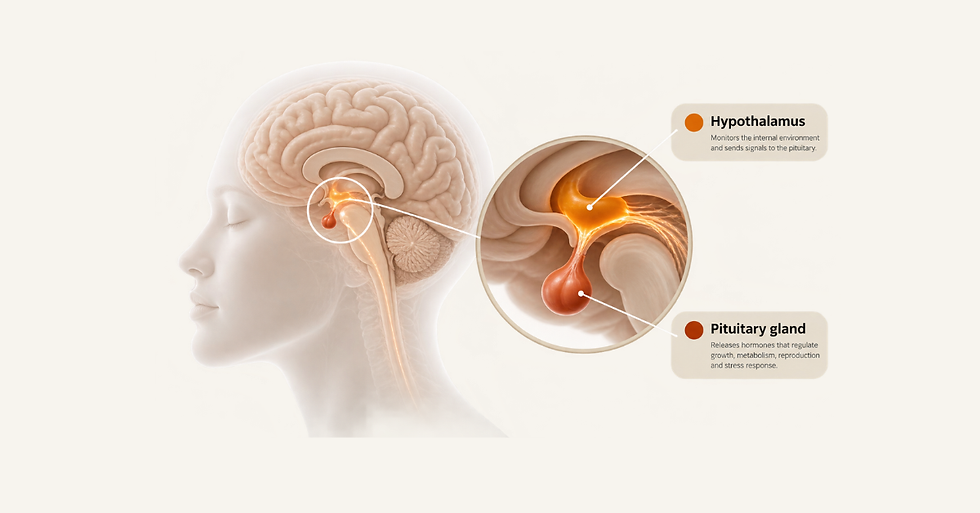
The previous article followed one stress response from beginning to end: the three-organ relay, what cortisol does while it is circulating, and the negative feedback that closes the loop.
That article covered the third of four questions in this series, which was what your body did.
This one takes the fourth.
When the loop runs again and again over months, with too little room in between, something accumulates.
Stability through change
Your body does not hold its values fixed.
Blood pressure climbs to meet the morning and falls again at night.
Glucose is released and cleared.
Inflammatory signalling rises to deal with an injury and then resolves.

The physiologist Peter Sterling called this allostasis, stability achieved through change rather than through holding still.
To understand allostasis, imagine riding a bicycle.

You don't stay balanced by keeping your body completely stiff and frozen; instead, you constantly lean, shift your weight, and adjust your handlebars to stay upright when you hit bumps or windy spots.
Your body does the exact same thing!
Internal levels like blood pressure, blood sugar (glucose), and inflammation do not stay locked at one single, fixed number.
Blood pressure climbs to help you wake up and meet the morning, then falls at night.
Glucose is released when you need quick energy and cleared when you rest.
Inflammation rises to heal a scrape or fight off a bug, and then resolves when the job is done.
This flexibility is the whole point of your body's design.
Allostatic load is the cost of running that flexibility continuously. When the next demand keeps arriving before the previous one has settled, the settings drift.
Inflammatory markers do not fully resolve between exposures.
Glucose regulation loosens slightly.
Resting cardiovascular tone shifts.

Imagine carrying a backpack. Carrying a lunchbox in your bag for an hour is easy. But if people keep dropping heavy rocks into your backpack without giving you a chance to take a break and unpack, your shoulders get tired, your posture changes, and you start dragging your feet.

Allostatic load is the biological cost, or "wear and tear," of running that constant physical flexibility continuously without enough time to recover.
When a new challenge or stressor keeps arriving before the previous one has settled, your body's internal settings quietly begin to drift:
Blood sugar regulation loosens slightly.
Resting heart rate and blood pressure settings shift upward.
Inflammatory signals don't completely clear out between stressful events.
On any single day, none of these small changes feel dramatic, which is precisely why allostatic load can build up unnoticed for years.
The evidence that this matters
Researchers gathered up every study they could find on this question and combined the results into one bigger picture.
People whose stress had built up the most were
22 % more likely to die of any cause
and 31 percent more likely to die specifically from heart and blood vessel disease
compared with people whose stress load had not built up as much
(Parker et al., 2022, American Journal of Preventive Medicine).
All seventeen studies pointed the same way.
A separate review combining 267 different studies found the same basic pattern, across many different physical and mental health problems
(Guidi et al., 2021, Psychotherapy and Psychosomatics).
Things worth knowing about those numbers: The studies also did not all measure stress load in exactly the same way. And none of this proves that stress load directly causes death.
Researchers followed groups of people over time and watched what happened, rather than testing it directly in an experiment. That kind of study can show two things are linked. It cannot, by itself, prove one caused the other.
What holds up is the pattern itself, showing up again and again across very different groups of people and different studies.
The finding that changes what you look at
For thirty years, one big criticism of this idea was that different researchers measured it in different ways, which is part of why the studies did not agree closely with each other.
In 2023, one group tackled that problem head-on. They combined the actual data from 67,126 people, aged 40 to 111, across thirteen long-term studies, looking at 40 different body measurements spanning twelve body systems.
They wanted to find the smallest set of measurements that could still predict health outcomes just as well. They found 5, and this small group predicted death from any cause as well as, or better than, the bigger, more complicated versions:
a marker of inflammation called C-reactive protein
resting heart rate
"good" HDL cholesterol
the ratio of your waist size to your height
and a blood sugar marker called HbA1c
Cortisol is not one of them.
That is worth pausing on, because it changes how you should think about the whole subject.
Cortisol is the messenger that sets off the stress response. What actually builds up over years is not the messenger itself. It is what that messenger keeps doing to the rest of the body: inflammation that never quite settles down, blood vessels that stay slightly more tense than they should, fat handling that shifts, fat that moves to different places in the body, blood sugar control that gets looser.
How far the recovery story can be pushed
The cortisol spike itself is a normal, healthy response, and what actually matters is whether your body comes back down to normal afterward, cleanly.
One study tested this directly.
Researchers put 130 healthy people through the same stressful task, then measured two separate things: how much each person's cortisol rose and how quickly it came back down afterward
They then checked both against signs of long-term stress. Recovery did not turn out to be a better sign of long-term stress than the initial rise was.
Only one specific thing, a bigger-than-normal cortisol jump right after waking up, was reliably linked to poor recovery, while the size of the initial spike was the thing linked to a smaller memory-related brain area. A study the following year added a further complication, finding no real overall link between daily cortisol patterns and how much someone's cortisol spiked under stress, and raising doubts about whether the usual ways of measuring "recovery" are even reliable in the first place.
Medical science is complicated...
The idea that recovery matters more than the spike is reasonable, and scientists are actively studying it, but it has not been proven yet.
What this leaves you with
You cannot measure your own build-up of stress with a cortisol test or a wearable device.
A saliva cortisol test only catches you at one moment on a curve that naturally rises and falls throughout the day.
A smartwatch stress score is built almost entirely from heart rate variability, sometimes combined with resting heart rate or skin temperature. HRV reflects the balance between the sympathetic and parasympathetic branches of the autonomic nervous system, the fast system that governs moment-to-moment arousal: heart rate, breathing rate, how quickly you calm down after a startle.
More useful: the five measurements that do carry real information are ordinary and easy to get.
C-reactive protein, HbA1c and HDL cholesterol all show up on a standard blood test. Resting heart rate and the ratio of your waist size to your height, you can measure yourself at home.
What matters is watching how those numbers move over several years, not any single result. If you have had blood tests more than once, that trend already sits in your medical records. Look at the direction those numbers are heading.
What comes next
This article has been about what builds up.
The next one is about why the same event costs two people entirely differently. Two colleagues give the same presentation to the same panel. One is exhausted for a day. The other is still not sleeping properly two weeks later. The difference is rarely the thing people assume it is.
If you take one thing from this
The next time you get routine blood work done, ask to see the older results next to the new ones. You are not looking for one abnormal number. You are looking for a direction: whether inflammation, blood sugar control and fat levels have been quietly drifting in one direction over several years. That slow drift is what built-up stress looks like once it becomes visible, and it becomes visible long before anyone would call it a disease.
Sleep is where recovery either happens or does not, and cortisol's own daily rhythm shapes how well the system resets overnight. In November I am running a small-group online workshop on that connection: why sleep shifts at this life stage, what the evidence supports, and how to build a starting protocol that fits your pattern.
Two live sessions, same content. Wednesday 4 November, 8:00 to 9:30 PM CET, or Saturday 7 November, 9:00 to 10:30 AM CET. €85 per person.
This is educational content, not medical advice. If you have concerns about stress or perimenopausal symptoms, consult a licensed clinician.
Evidence classification in this article follows The Filter framework: Evidence (peer-reviewed, replicated), Applicability (relevant to midlife women in real-world conditions), Health Benefit (meaningful, measurable outcome). Certainty language reflects the current state of the literature.
References
Parker HW, Abreu AM, Sullivan MC, Vadiveloo MK. Allostatic Load and Mortality: A Systematic Review and Meta-Analysis. American Journal of Preventive Medicine. 2022;63(1):131-140.
McCrory C, McLoughlin S, Layte R, et al. Towards a consensus definition of allostatic load: a multi-cohort, multi-system, multi-biomarker individual participant data (IPD) meta-analysis. Psychoneuroendocrinology. 2023;153:106117.
Guidi J, Lucente M, Sonino N, Fava GA. Allostatic Load and Its Impact on Health: A Systematic Review. Psychotherapy and Psychosomatics. 2021;90(1):11-27.
Degering M, Linz R, Puhlmann LMC, Singer T, Engert V. Revisiting the stress recovery hypothesis: Differential associations of cortisol stress reactivity and recovery after acute psychosocial stress with markers of long-term stress and health. Brain, Behavior, & Immunity - Health. 2023;28:100598.
Wesarg-Menzel C, Marheinecke R, Staaks J, Engert V. Associations of diurnal cortisol parameters with cortisol stress reactivity and recovery: A systematic review and meta-analysis. Psychoneuroendocrinology. 2024;163:106976.
Want one piece of health science made clear each week? Start with the free guide, 5 evidence-based habits for a longer, healthier life and receive the Human Recipe newsletter.
Human Recipe is a science-driven medical literacy platform
that combines medical expertise with intelligent, future-focused tools, helping people turn
clinical insights into sustainable daily habits for a longer, healthier life.

Dr. Caroline De Graeve, MD, is a physician and founder of Human Recipe. She trained in medicine and nutrition science (Stanford University’s Nutrition Science program). Her work focuses on translating evidence-based lifestyle medicine into clear, practical guidance for women in midlife and beyond.


Comments